My workbench told the story before I did, because by the end of the first weekend it was covered in jars, wire offcuts, spare lids, and a notebook where I had started keeping a test log for every fitting I tried, with a column for what held, a column for what leaked, and a column for what I changed next. I did not set out to make ten feeders at once. I set out to find out whether one ordinary mason jar could be turned into a reliable feeder without a lot of special parts, and the answer kept changing with each kit, each wire gauge, and each way of hanging the jar, so I kept testing, one jar at a time, until I had a bench full of versions that each worked in a different spot. The jar itself is the constant in all of this, cheap, clear, and easy to find, and the glass lets me see the seed level without opening anything, which turned out to matter more than I expected on cold mornings when I did not want to take a feeder apart just to check it.
The rule I gave myself for the whole run of tests was simple: every version had to survive a week outside, through wind and at least one rain, before I called it finished, and if it leaked, tipped, spilled, or scared the birds off, it went back on the bench for a fix, no matter how good it looked hanging from a branch. That rule cost me a few pretty failures and saved me from hanging feeders that would have failed in the yard, and it is why the ten ideas below read like lab notes as much as craft projects, with the fit, the leak, and the change recorded for each one, so anyone copying them can skip the versions that did not hold.
1. Classic Wire-Wrapped Hanging Mason Jar Feeder
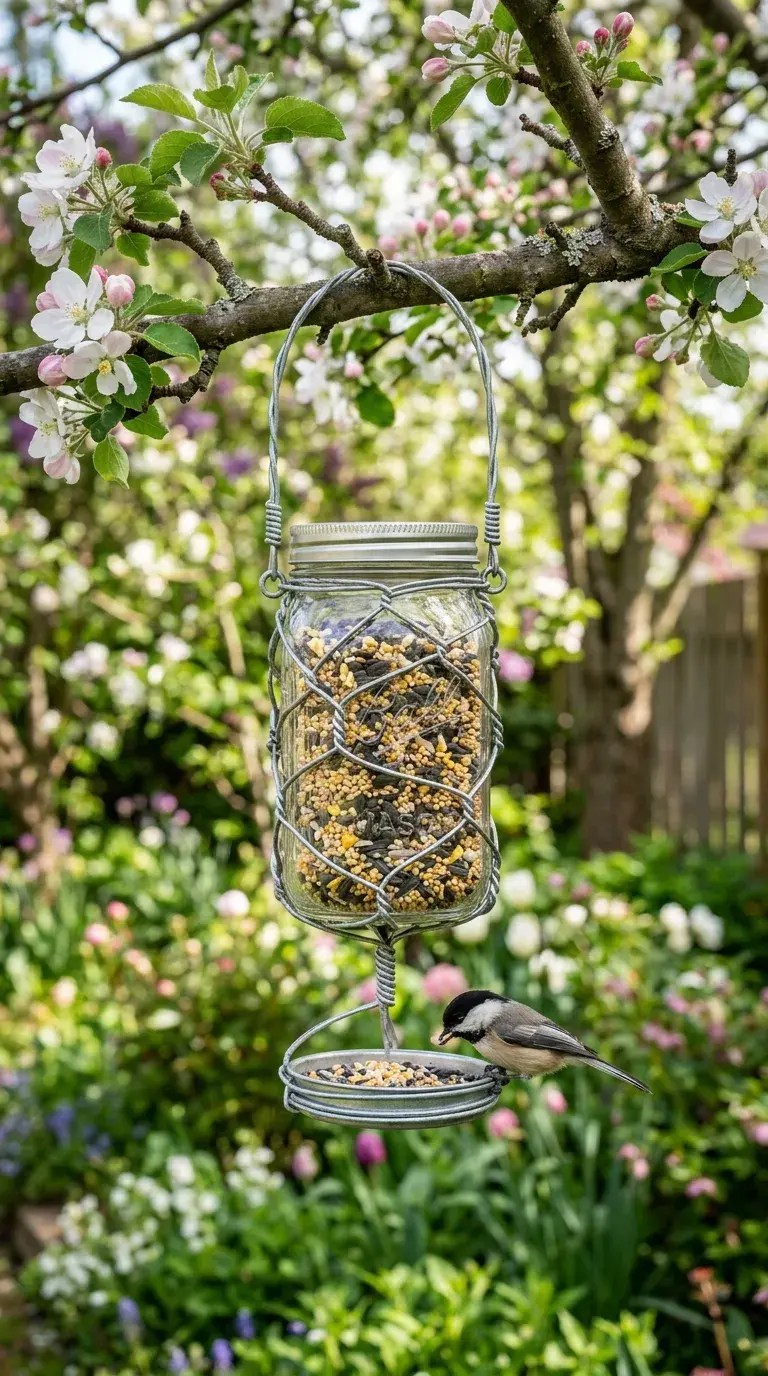
The first test on the bench was the simplest one, a standard quart jar, a length of heavy galvanized wire, and a pair of pliers, and I learned within the first wrap that heavy wire is not a suggestion, because the light craft wire I tried first stretched under the weight of a full jar and let the loop sag. I wrapped the wire around the neck and the body of the jar, twisting it tight with the pliers and shaping the ends into a loop and a hook, and I tested that hook by raising the jar and rocking it softly above the bench, the same check I use for anything that will hang over a walkway, and the heavy wire held without slipping. Hung from a branch, a hook, or an overhang, the jar sits open at the top, and birds perch right on the rim to eat, which looks a little precarious the first time you see it and turns out to be perfectly natural for them, since the rim gives a firm edge to grip. I filled this version with mixed seeds, sunflower kernels, and safflower, and the clear glass showed the refill need at a glance, the seed level dropping visibly day by day, so I never had to guess, and the fix that made this feeder pass its week outside was simply the heavier wire and a second twist at the neck, after which it hung steady through wind and rain without a single spill.