10. Moss-Covered Flower Foam Ball
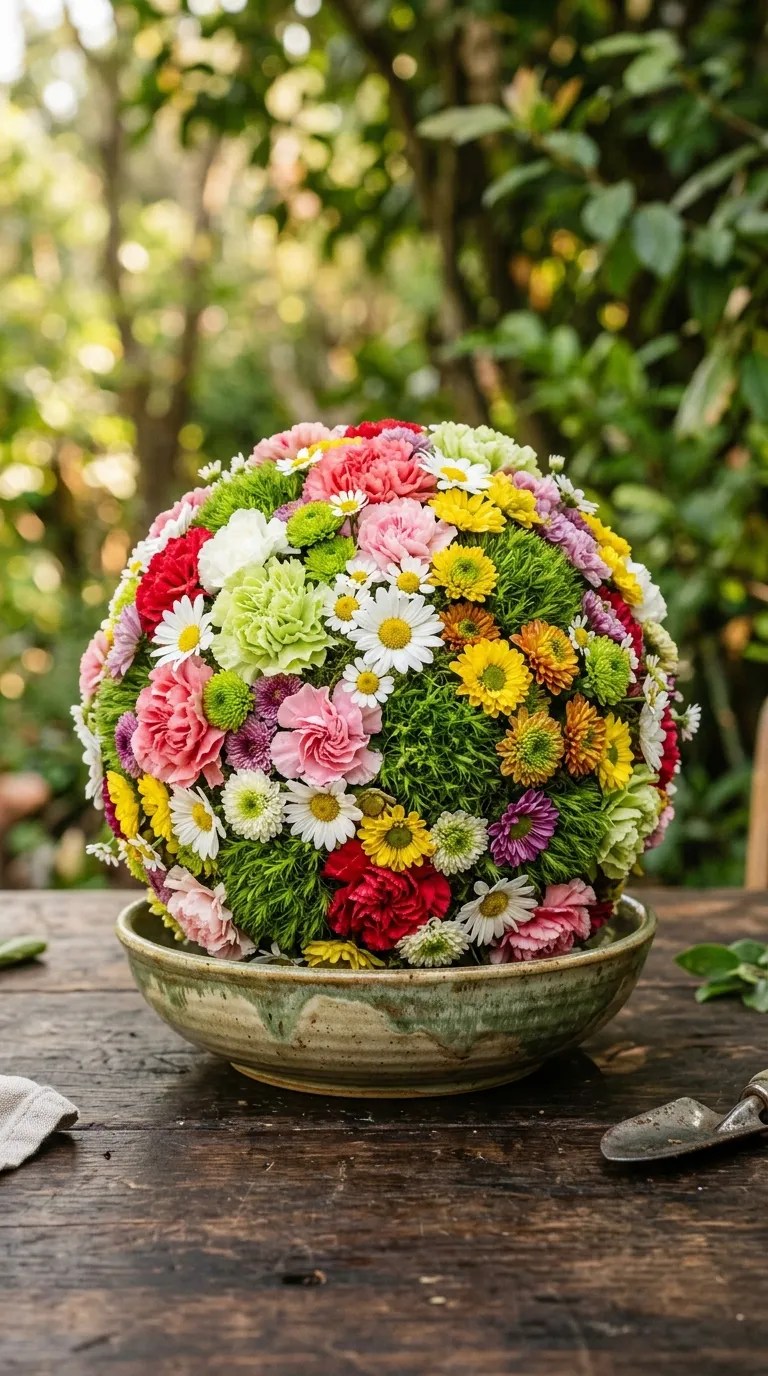
The foam ball is heavy when it is soaked, and I lift it with both hands, holding it over the tray until it stops dripping. I cover the entire ball with sheet moss, securing it with floral pins or hot glue, pressing the moss in slowly and turning the ball as I go, until no foam shows. Then the flowers, small to medium blooms like carnations, daisies, or chrysanthemums, stems trimmed to about two to three inches and inserted at various angles, covering the moss completely, the largest blooms first, then smaller flowers and greenery filling in.
Materials: Floral foam ball, sheet moss, fresh flowers (small to medium blooms like carnations, daisies, or chrysanthemums), floral pins or hot glue gun, water, large bowl or tray (to catch drips).
How to: Soak the floral foam ball in water until it’s fully saturated. Cover the entire ball with sheet moss, securing it with floral pins or hot glue. Trim the flower stems to about 2-3 inches and insert them into the foam at various angles, covering the moss completely. For a balanced look, place the largest blooms first, then fill in with smaller flowers and greenery.
Time: 45-60 minutes | Difficulty: Intermediate
Display Suggestion: Place the foam ball in a shallow bowl or on a decorative plate to catch any water drips. This centerpiece works well as a standalone piece or as part of a larger tablescape with candles, fruit, or other natural elements.
Pro Tip: To keep the foam ball hydrated, mist it lightly with water every day. If the flowers start to wilt, recut the stems and reinsert them into the foam for a fresh look.
What are the best flowers for table centerpieces?
The best flowers depend on the occasion, the season, and your personal style. Long-lasting blooms like roses, carnations, and alstroemeria are great for events where the arrangement needs to stay fresh for several days. For a romantic look, I consider peonies, ranunculus, or garden roses. For a wild look, I opt for wildflowers, daisies, or queen Anne’s lace, with greenery like eucalyptus or ferns.
How do I make my flower centerpiece last longer?
I start with fresh, high-quality blooms, trim the stems at an angle, and remove any leaves that will sit below the waterline to prevent bacterial growth. I change the water every two days, and I recut the stems if the flowers start to wilt. I keep the arrangement out of direct sunlight and away from heat sources, as these can cause the flowers to dry out more quickly.
Can I use grocery store flowers for a centerpiece?
Absolutely, and I do, often. Grocery store flowers can be just as beautiful as those from a florist, and they are often more budget-friendly. I look for blooms that are just starting to open, as they will last longer. I stick to one or two types for a cohesive look, or I mix and match for a more eclectic vibe, experimenting with different colors and textures.
What are some budget-friendly alternatives to traditional vases?
If I do not have a traditional vase on hand, I look around the kitchen first, because almost any container can become a vase with a little imagination. Mason jars, glass bottles, teacups, or even tin cans can all work beautifully. For a rustic look, I try a wooden box or a hollowed-out piece of fruit like a pineapple. I can also use a shallow bowl or platter for a floating flower centerpiece.
How do I choose a centerpiece that matches my table setting?
I consider the style, the color scheme, and the size of the table setting, and I walk around the table while I consider them. For a formal dinner, a tall, elegant arrangement in a classic vase works well. For a casual brunch, a low, sprawling centerpiece in a rustic container might be more appropriate. I match the colors of the flowers to the table linens, plates, or napkins. A large, long table can handle a bigger centerpiece, while a small, round table might need something more compact.
Can I mix real flowers with faux flowers in a centerpiece?
Yes, with a few things kept in mind. I make sure the faux flowers are high-quality and look realistic. I place the faux flowers where they will not be touched or handled, as they cannot be recut or rehydrated like real flowers. I keep the real flowers in water to ensure they stay fresh. Mixing real and faux can create a long-lasting centerpiece, especially for events where the arrangement needs to hold up for several days.
What’s the best way to arrange flowers for a round table?
For a round table, I use a low, symmetrical centerpiece, because it allows guests to see and converse with each other across the table. I start with a focal point in the center, such as a large bloom or a cluster of flowers, and then I build outwards with smaller blooms and greenery, turning the arrangement as I go so it stays even. I keep the arrangement compact so it does not take up too much space. I can also use a circular tray or shallow bowl as a base to help define the shape.
Fresh flowers have a way of making every gathering feel a little more special, and with these 10 table centerpiece ideas using fresh flowers, you are sure to find the perfect inspiration for your next event. Whether you are drawn to the classic elegance of a glass vase or the whimsical charm of a hanging basket, each design offers a unique way to bring nature indoors. You do not need to be a professional florist to create something stunning. You need a bucket of water, a pair of shears, a little creativity, and a love of blooms.
So pick an idea that speaks to you, gather your materials, and let your imagination run wild. Personalize it with your favorite colors, textures, and containers. Walk around the table when you are done, the way a guest would, and look at it from every chair. The most memorable centerpieces reflect your personal style and the joy of the occasion.