The eucalyptus reached my hands first, still bound with a paper band, leaves papery and cool, tiny seeds tucked along each stem. I bent a sprig gently and it held its curve without snapping, which told me how it wanted to sit on a hoop. I start every wreath this way, not with a picture in mind, but with the material in my hands, turning it over to feel how stiff, heavy, or open it is. The material decides the shape before I do.
Quick Guide to Fall Wreath Making: I build on a grapevine or wire frame, choose sturdy botanical or textile elements that hold shape on a door, and fasten them with floral wire or hot glue, whichever the material asks for. I layer larger foliage first, then add smaller accents into the gaps, and finish with outdoor-safe ribbon when the wreath will face weather. The textures I return to are dried florals, berries, burlap, and metallics, since a wreath that feels varied up close still looks rich from the sidewalk.
Wheat feels nothing like flannel. Wheat is dry and light and rustles, and it wants to fan outward in a halo. Flannel is soft, thickens in my palm, and wants close knots until the frame disappears. Eucalyptus wants a curve. Hydrangea wants tight packing. Pinecones want wire, not glue alone, because they are heavy and will drop when temperatures shift. When I let each material lead, I make fewer mistakes, because I stop forcing stiff stems into soft shapes or asking paper to survive rain.
I keep wire snips, a glue gun, floral wire, scissors, and a rag close, and I work on newspaper so glue strings have somewhere to land. I step back often to judge the wreath from a distance, since fullness at arm’s length can look thin from the front door. The ten wreaths below each began with a different material in my hands, and each one showed me how that material behaves when wired, glued, wrapped, or knotted into a circle.
1. Preserved Seeded Eucalyptus and Amber Berry Hoop Wreath
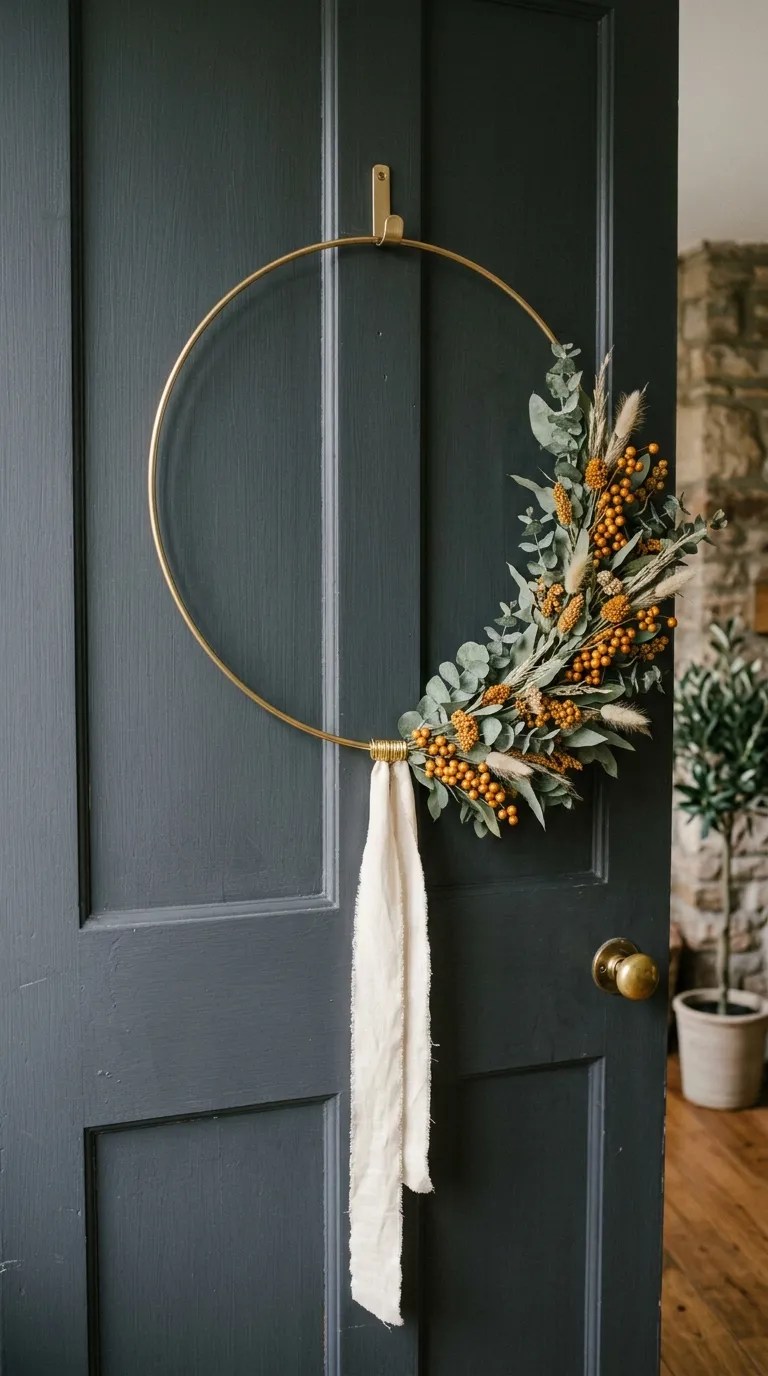
The seeded eucalyptus felt dry and slightly crisp, leaves clicking softly when I shook a bundle. I had a 14 to 18 inch metal macrame hoop, 2 bundles of preserved seeded eucalyptus, 1 stem of artificial amber berries, thin green floral paddle wire, wire snips, and 2 yards of frayed linen ribbon. The hoop was smooth and slick, and my first wires slipped, so I needed grip before beauty. I cut sprigs 4 to 6 inches long and gathered bundles of 3 to 4 sprigs, fanning leaves so each bundle looked full.
I wired the first bundle tight along the lower-left curve, wrapping wire around stems and metal until it stopped shifting. I laid the second bundle over the exposed stems, working clockwise to cover about one third of the circumference, so stems hid under leaves flowing one way. I wired berries flush into dense leaves, tucking stems deep so berries sat among foliage. A shorter reversed bundle went on the opposite lower edge, meeting the first bundles at bottom center. I tied an asymmetrical bow with long tails past the bottom rim. It took about 45 minutes and needs minimal experience. It suits dark doors, charcoal, navy, or deep forest green. Pro Tip: Wrap florist tape on the metal where stems attach for traction, so bundles do not slide once hung.