I stopped asking where I could put one more thing and started asking where space was already sitting unused, and that one shift changed how my apartment looked to me. I stood in the doorway of each room with nothing in my hands and let my eyes travel slowly from the floor to the ceiling, past the furniture I used every day and into the gaps I had trained myself not to see. The strip of wall above a door frame, the dark hollow under the bed, the flat back of a closed door, the corner where two walls met and nothing ever landed, all of it was dead space, and all of it was holding nothing while my counters and closet floor overflowed. I carried a tape measure and a pencil, and I marked the spots that could carry weight, hold a jar, or hide a blanket without taking a single inch from the floor I walked on.
I did not tear anything apart to find those spots, and I did not drill where a lease would punish me for it. Some fixes in this list need a stud and a solid anchor, and I say so plainly when they do, because a shelf that pulls out of drywall is worse than no shelf at all. Others were made to come down clean when I move, with hooks, strips, rods, and lean-to frames doing the work instead of holes. Every one of them started as a small patch of nothing, and every one of them had to prove it could hold what I put on it, day after day, before I trusted it with books, dishes, or the bedding I actually sleep under.
1. Floating Industrial Pipe Shelves
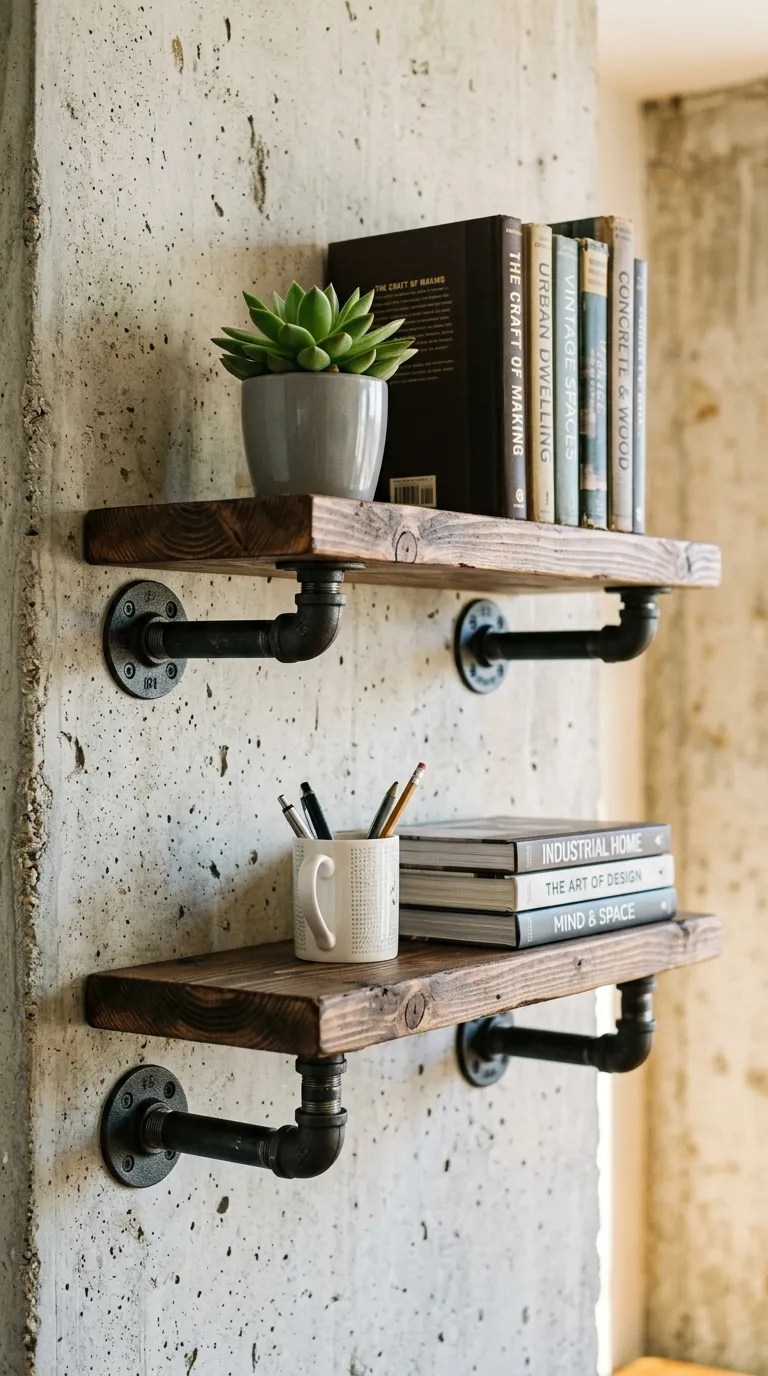
The first dead space I caught was the bare wall above my work table, a wide rectangle of paint that ended well short of the ceiling and carried nothing at all. I measured it twice, because a shelf that looks level from the doorway can still sit crooked once books go on it, and I wanted the brackets to land where the wall could actually hold them. Black iron pipes, elbows, and flanges gave me the frame, and pre-cut wooden boards gave me the surface, and the combination looked deliberate instead of makeshift once the boards were sanded smooth and finished with stain or paint. I sanded until my hand could slide across a board without catching, then I let the finish dry fully before I put anything near it, since a tacky board will mark a book spine and hold dust in the grain.
I built the brackets by screwing the pipes into the flanges and elbows until each joint felt tight and square, and I checked the shape against the wall before I committed to a single hole. The flanges went into wall studs wherever I could find one, and where no stud lined up with the bracket I used heavy-duty toggle bolts made for that kind of load, because the whole point was storage I could trust with weight. I set the boards across the brackets and secured them from underneath with metal U-straps, so a board could not tip forward when I pulled a jar off the front edge. That wall now holds heavy books, pantry jars, and plants, and the floor underneath it stays clear for my chair and my feet, which was the trade I wanted from the start: storage that rises instead of spreads.